
About
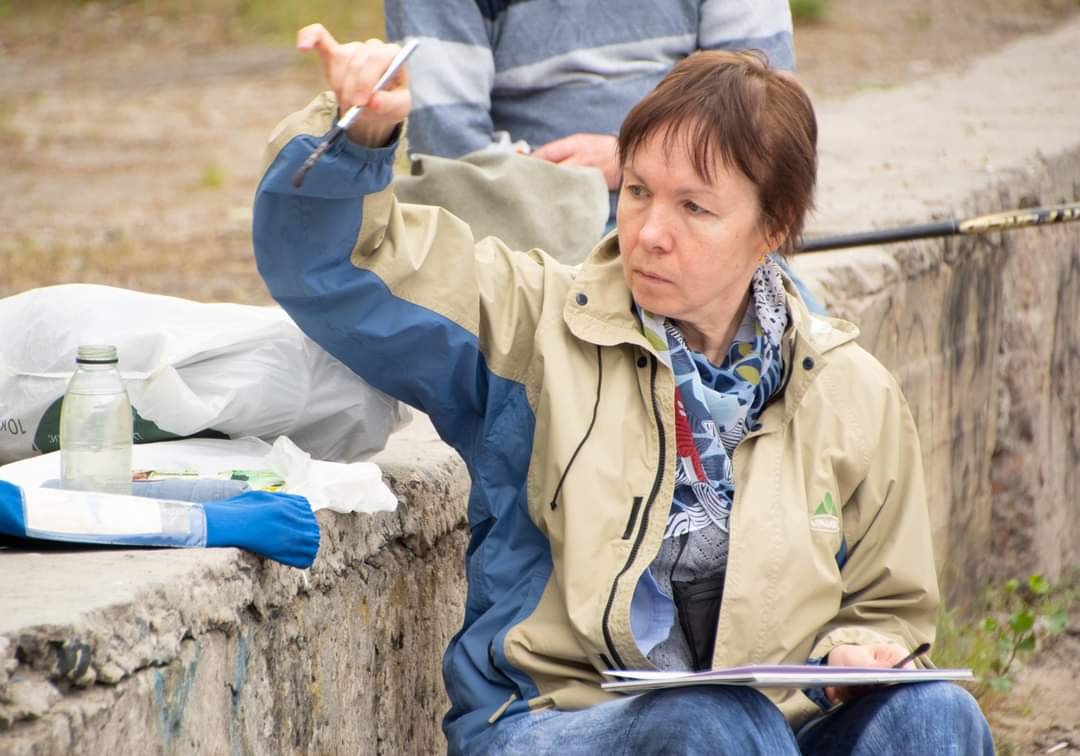
Short BIO
Olga Karpenko (Olly) is a Ukrainian visual artist from Kyiv, currently based in Finland. She works primarily with watercolour, monotype, ink drawing and composite works on paper. Direct observation is central to her practice, which moves between natural forms and the structures of everyday urban life. Experiment is equally important: through monotype, changes of scale, simplification and the rearrangement of painted fragments, an observed subject can acquire a different form.
Her major projects include Fish Day, Ljutyj 2022, #KyivCityExpress and Helsinki–Kyiv.
Since 2022, her work has reflected the changes that Russia’s full-scale invasion brought to familiar places and everyday life in Kyiv.
In 2026, she took part in the Artists at Risk Safe Haven Helsinki Residency, where she developed Helsinki–Kyiv, later shown at Myymälä2 Gallery.
Olly has presented solo and group exhibitions in Ukraine and internationally and has been a member of the National Union of Artists of Ukraine since 2024.
Her work has also appeared in literary and art publications.
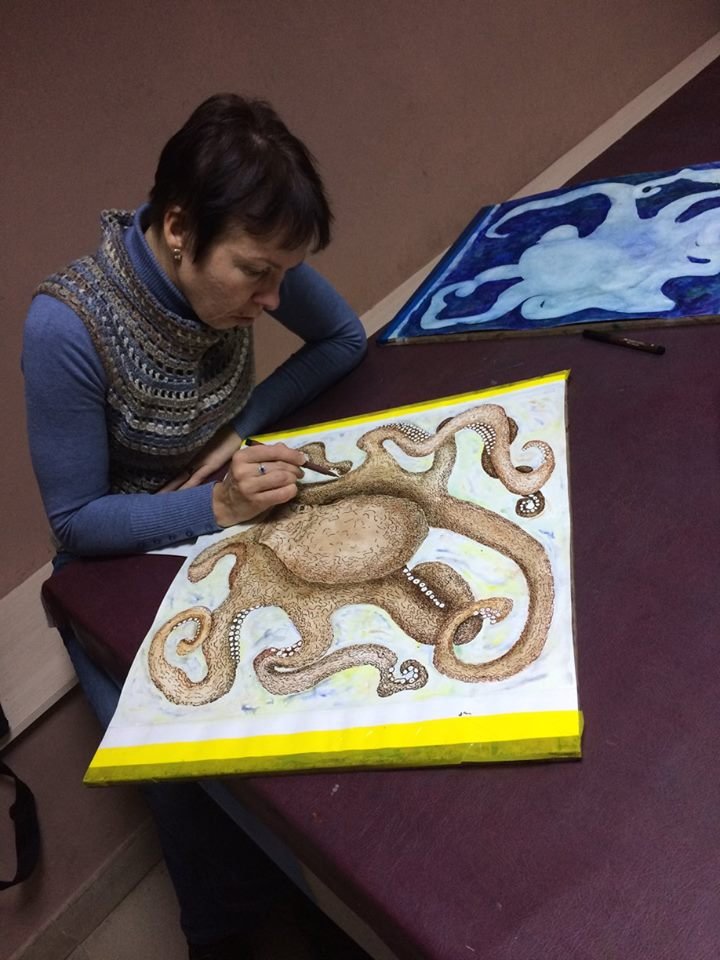
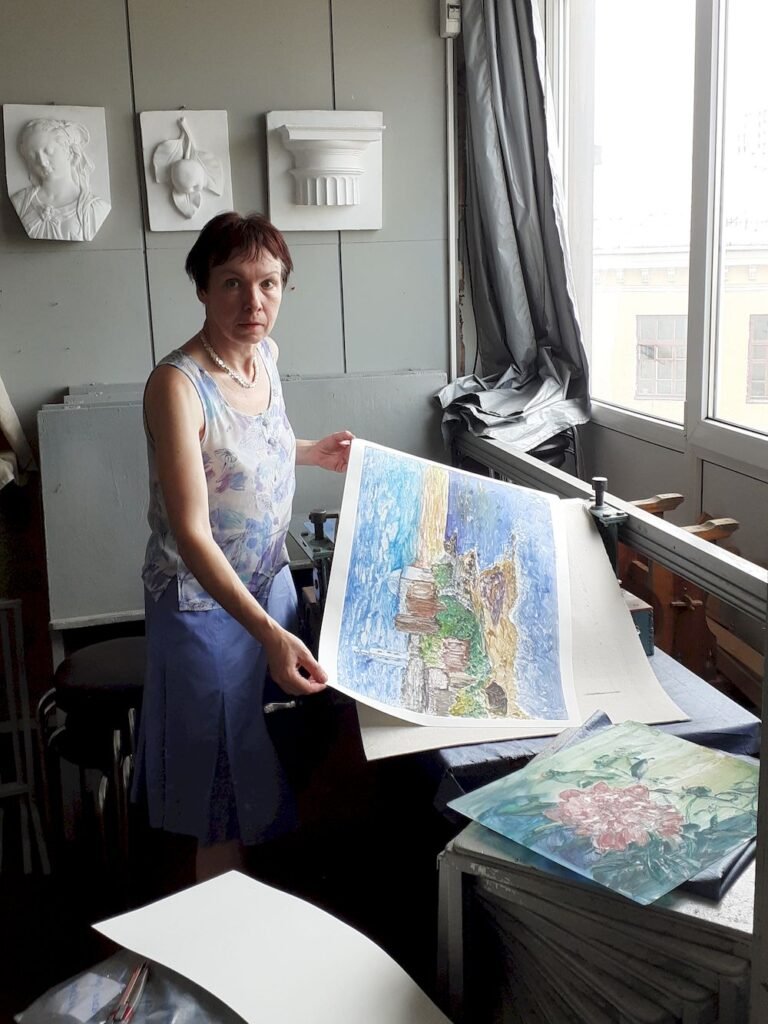
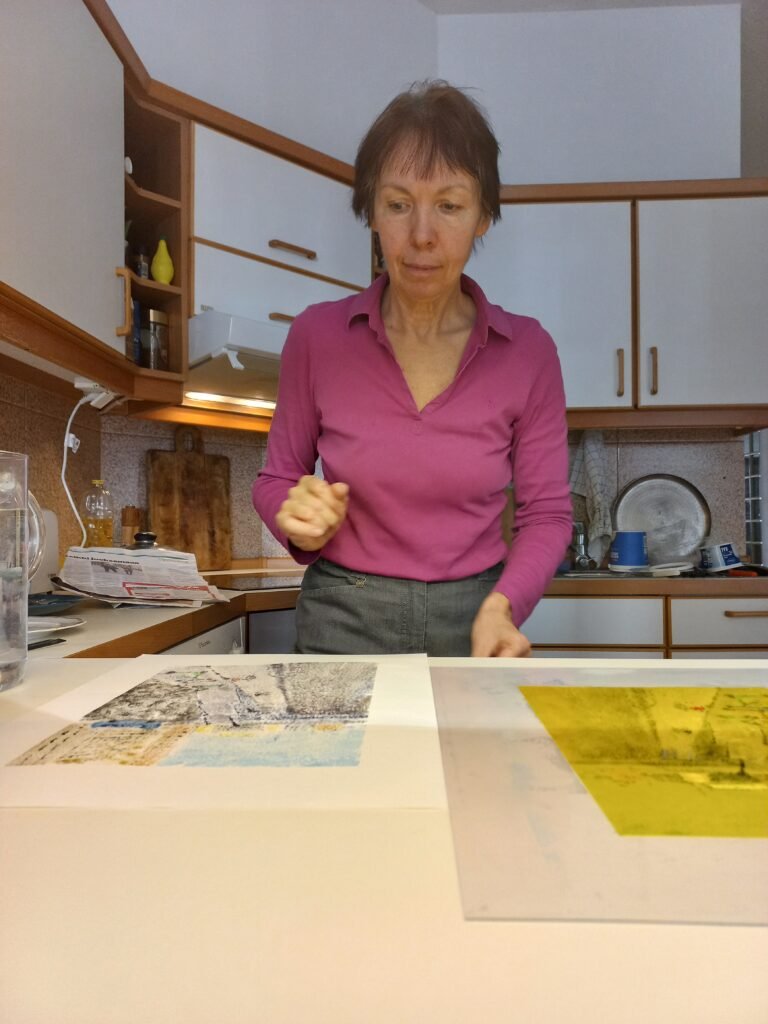
Fragments of Process
About My Work
I rarely begin with a clearly formulated question. More often, something in the visible world holds my attention before I understand why. I may already know that I want to work, or have an idea that has not yet found its form, but I do not know the image in advance. I look until something offers a way forward — a structure, a movement, a relationship between forms, a patch of light. The world suggests; the artist selects. Only then does the question begin to take shape.
From that point, direct observation is no longer a set of instructions. The centre of attention has to move from the subject onto the sheet, and the image has to begin working on its own. I change scale, move figures, remove or add details, and sometimes rely on memory rather than the original view. A work succeeds for me when the reason I stopped to look has moved from the world onto the sheet strongly enough for someone else to encounter it there.
I want the work to make the question visible. My image is one possible answer; the viewer does not have to arrive at the same one. This is partly why exhibitions and publications matter to me: they let me test whether someone else can see what made me stop, even if they understand it differently. Sometimes a viewer’s response makes me look again at a work I had thought was finished.
I came to art with habits formed elsewhere. My first professional field was mathematics. I loved the beauty of a good solution: an unexpected step, a clear structure, a difficult problem suddenly becoming simpler. Later, years of work with drawing tests taught me to look closely at line, placement, scale, detail, pressure, rhythm, and the order in which a drawing was made. When I began studying art systematically, that habit of analysis found a different use. I learned to set an artistic task, compare sketches, change the format or technique, and treat an unsuccessful work as a problem that could be understood and sometimes solved.
For a long time, most of my subjects came from living nature — flowers, trees, fish, water, and the underwater world. During the Covid restrictions, when my range of movement narrowed, the city entered my work more strongly. Later, war changed both what I saw and how I moved through Kyiv, and urban landscape became an important part of my practice. I do not choose a new “theme” and then look for material to fit it. I work with what is around me, and within it I still have to recognise what can become an image.
I do not have a fixed rule for choosing a medium. Watercolour keeps me close to colour and light, while every mark changes what can happen next. Sepia and ink make me think first in tone, silhouette, and structure. In monotype, transfer, reversal, pressure, and accident alter the image before I can fully control it. Sometimes one work is enough; often it is not, and a series begins. More recently, I have also begun cutting and rearranging fragments of finished watercolours and monotypes, using completed works as material for a new image.
I learned in Helsinki how little of a project may exist in advance. I arrived knowing that I wanted to work with the city and that I could also return to several unfinished or remembered subjects from Kyiv. I did not yet know what Helsinki–Kyiv would be. Only after the first works did I begin to see how the two cities could belong in the same series. The project grew because one image began to ask for another.
What interests me now is how far an image can move from what I first saw without losing the reason it began. I may simplify it, change its scale, move elements, or build a new work from fragments of finished ones. The image does not have to preserve everything I saw. It has to preserve the impulse that made the work necessary. What the viewer finds there is no longer mine to decide.
Contact
WhatsApp/ Telegram/Viber
+380960885677
olly.olga@gmail.com

